How to Choose the Right Relief Valve for Your Needs?
Selecting the right relief valve is crucial for system safety and efficiency. According to industry expert John Smith, "Choosing the correct relief valve can save you time, money, and prevent system failures." With so many options available, it’s essential to understand your specific needs before making a decision.
Relief valves manage pressure and prevent potentially dangerous situations. Factors such as fluid type, pressure requirements, and system design play vital roles in this choice. Many users overlook these aspects, leading to mismatches and operational issues. A misguided selection can result in equipment failure or costly downtime.
Evaluating your requirements can be daunting. Take the time to analyze your system's needs. Reading spec sheets and consulting with manufacturers can help clarify your options. But remember, sometimes advice from trusted colleagues is invaluable. Reflect on past experiences; they can guide you toward a more informed decision.

Understanding the Functionality of Relief Valves
Relief valves play a crucial role in maintaining safety and efficiency in various systems. Understanding their functionality is essential for making informed choices. A relief valve opens to release excess pressure, preventing catastrophic failures. This simple mechanism often goes unnoticed but is vital in industries like oil, gas, and manufacturing.
When selecting a relief valve, consider the specific application. The pressure settings must match system requirements. This is where a common pitfall arises. Many overlook the importance of accurate pressure ratings. Choosing a valve that’s too high or low can lead to operational hazards. You may encounter issues like valve chatter or premature wear.
Material selection is also significant. Different media require specific materials to ensure durability. A valve that works well in one environment may fail in another due to corrosion or temperature fluctuations. Assess your system's conditions thoroughly. Review maintenance protocols to ensure the valve functions as intended over time. Being mindful of these details can save you from serious complications.
Identifying Your Specific Application Requirements
When selecting a relief valve, identifying your specific application requirements is crucial. Start by assessing the media involved. Is it a gas or liquid? Each type requires different valve features. Consider the pressure and temperature ranges within your system. These factors influence the valve’s material and design.
Tip: Review your system’s specifications carefully. Sometimes the smallest detail can lead you to the wrong choice. For example, a valve rated for higher temperatures may not be suitable for lower temperatures. Misjudgment here can cause failures.
Think about the installation environment too. Will the valve be exposed to harsh conditions? Corrosion-resistant materials might be necessary. Also, take note of the pipe size and connection type. Compatibility is key for effective performance.
Tip: Don’t ignore manufacturer guidelines. They provide essential insights on performance and maintenance. Overlooking them can lead to serious issues. A valve that seems perfect on paper may not function properly in real-world situations.
How to Choose the Right Relief Valve for Your Needs?
| Application Type |
Pressure Rating (PSI) |
Material |
Size (Inches) |
Set Pressure (PSI) |
Temperature Range (°F) |
| Water systems |
150 |
Brass |
2 |
130 |
32 to 140 |
| Oil and gas |
3000 |
Stainless Steel |
1 |
2800 |
-20 to 200 |
| Chemical processing |
250 |
Titanium |
3 |
220 |
-40 to 300 |
| Steam systems |
600 |
Carbon Steel |
4 |
580 |
0 to 600 |
Evaluating Different Types of Relief Valves Available
Selecting the right relief valve is crucial for system safety. Various types are available, each serving specific applications.
Pressure relief valves (PRVs) and safety relief valves (SRVs) are commonly used.
According to industry reports, PRVs can handle pressures up to 6,000 psi, making them suitable for high-pressure systems.
While PRVs are effective, they may not fit every situation. For instance, SRVs are designed to relieve pressure while maintaining a constant flow, important for protecting equipment from overpressure conditions.
Some reports note that up to 30% of system failures can be traced back to improper relief valve selection. This highlights the need for detailed evaluations.
Material and compatibility are critical in choosing a valve. Some materials deteriorate under certain conditions, leading to failures. Depending on the application, a stainless steel valve may be preferable to plastic.
The right choice can extend service life and reduce maintenance costs. Yet, many operate on outdated valve data, risking operational safety.
Regular assessments and updated training are vital.
Considering Size, Pressure, and Flow Specifications
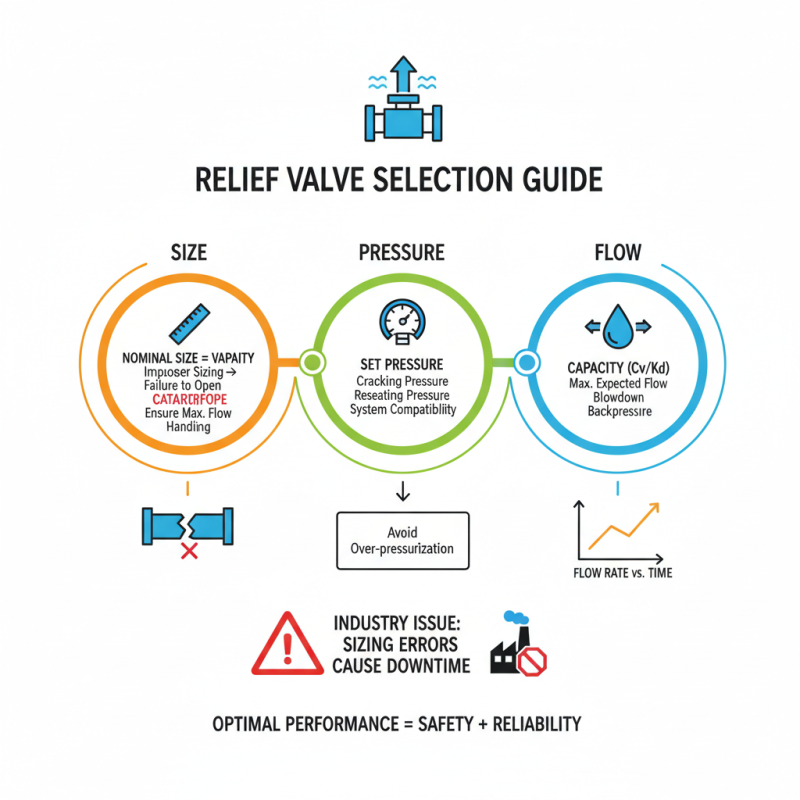
Choosing the right relief valve involves understanding size, pressure, and flow specifications. Each component plays a crucial role. An improperly sized relief valve may not open when needed. This could lead to catastrophic failures in systems. Proper sizing ensures the valve can handle the maximum expected flow. According to industry reports, a valve’s capacity is often defined by its nominal size. Yet, many manufacturers report sizing errors lead to significant downtime.
Pressure ratings are another critical factor. Engineers must match the valve’s pressure rating to the system’s pressure. Underestimating this can cause the valve to fail prematurely. Reports highlight that nearly 30% of relief valve failures result from poor pressure compatibility. Users should also consider flow specifications. A valve limited in flow may prevent proper system operation. Ultimately, the flow capacity should align with the system’s maximum demand to avoid backpressure.
Tip: Always consult a pressure and flow chart before making a selection. Seek recommendations from experienced professionals. Keep in mind that data should be regularly reviewed. As systems evolve, so should the specifications of your relief valve. Sometimes, it isn't just about getting a valve; it’s about getting the right one for each unique scenario.
Assessing Maintenance and Safety Features of Relief Valves
When selecting a relief valve, assessing maintenance and safety features is crucial. A relief valve is essential for pressure management. It prevents equipment failure and ensures operational safety. According to the American Society of Mechanical Engineers (ASME), improper maintenance can lead to serious accidents. More than 45% of reported failures stem from neglected maintenance protocols.
Regular maintenance checks are necessary. These valves may require adjustment and testing. A study by the National Board of Boiler and Pressure Vessel Inspectors indicates that valves not tested annually face a 55% increased risk of malfunction. The safety features of a well-designed relief valve can minimize this risk. Look for valves with automatic reset functions. They provide an added layer of reliability and ease of use.
Installation location matters too. Placing the valve in a hard-to-reach area complicates maintenance. Operators may skip regular inspections due to inconvenience. Striking a balance between functionality and accessibility is key. Identifying these details can be challenging. However, ignoring them could lead to expensive failures. The consequences of overlooking maintenance features can be costly and dangerous.
 North American Safety Valve Industries, Inc.